
The landscape of internet regulation in the United States is once again shifting, with the Federal Communications Commission (FCC) poised to reintroduce robust FCC Net Neutrality rules. For Internet Service Providers (ISPs) across the nation, this isn’t just another policy change; it’s a fundamental redefinition of operational parameters that demands immediate and strategic attention. With a looming deadline of March 2026, understanding and preparing for these changes is paramount to ensure continued compliance, avoid penalties, and maintain a competitive edge.
The concept of FCC Net Neutrality has been a contentious topic for over a decade, fluctuating between different regulatory frameworks under various administrations. Essentially, net neutrality advocates for the principle that ISPs should treat all data on the internet equally, without discriminating or charging differently based on user, content, website, platform, application, type of attached equipment, or method of communication. This means no blocking, no throttling, and no paid prioritization of internet traffic.
The reclassification of broadband internet access service as a Title II telecommunications service under the Communications Act of 1934 grants the FCC more comprehensive authority to regulate ISPs. This move, which reverses a 2017 decision, places ISPs under stricter common carrier obligations, similar to traditional telephone companies. The implications are far-reaching, affecting everything from network management practices and pricing structures to consumer protection and privacy policies.
This comprehensive guide aims to dissect the upcoming FCC Net Neutrality rules, providing US ISPs with a clear roadmap for navigating the complex regulatory environment. We will delve into the historical context, outline the specific provisions of the new rules, analyze their potential impact on business operations, and offer actionable strategies for achieving compliance before the March 2026 deadline. Ignoring these changes is not an option; proactive engagement is the key to minimizing disruption and leveraging new opportunities.
The Historical Context of FCC Net Neutrality: A Regulatory Rollercoaster
To truly grasp the significance of the upcoming FCC Net Neutrality rules, it’s essential to understand the tumultuous history of internet regulation in the US. The debate over net neutrality can be traced back to the early 2000s, as broadband internet became increasingly prevalent and concerns arose about ISPs potentially abusing their gatekeeper role.
Early Principles and the Open Internet Orders
The FCC first articulated principles of an open internet in 2005, emphasizing consumer access to lawful content and applications. These principles were largely aspirational until 2010, when the FCC issued its first Open Internet Order. This order established initial rules prohibiting blocking and unreasonable discrimination by wired ISPs, though it faced legal challenges and was partially struck down by courts.
The 2015 Title II Reclassification
The landmark moment for FCC Net Neutrality came in 2015, when the FCC, under Chairman Tom Wheeler, reclassified broadband internet access service as a Title II telecommunications service. This move granted the FCC much stronger legal footing to enforce net neutrality principles. The 2015 Open Internet Order prohibited blocking, throttling, and paid prioritization, and also extended some Title II provisions, such as privacy regulations, to ISPs. This decision was largely supported by consumer advocacy groups and content providers, who argued it protected the open internet and fostered innovation.
The 2017 Rollback and the Restoring Internet Freedom Order
However, the regulatory pendulum swung back dramatically in 2017. Under Chairman Ajit Pai, the FCC repealed the 2015 rules and adopted the Restoring Internet Freedom Order. This order reclassified broadband as an information service, removing it from Title II oversight and largely deregulating ISPs. The argument was that deregulation would foster investment and innovation. This rollback sparked widespread public outcry and legal challenges, with many states implementing their own net neutrality laws in response.
The Path to 2026: A Return to Title II
The current administration has signaled a clear intent to restore strong FCC Net Neutrality protections. The recent FCC vote to reclassify broadband under Title II once again sets the stage for a return to the 2015 framework, albeit with potential modifications. This decision reflects a renewed belief that robust regulatory oversight is necessary to ensure a free and open internet for all Americans. The March 2026 deadline provides a critical window for ISPs to adapt to this significant policy shift.
Understanding the New FCC Net Neutrality Rules: Key Provisions for ISPs
The reintroduction of FCC Net Neutrality rules under Title II brings with it a suite of specific provisions that US ISPs must meticulously understand and implement. While the final text of the rules may yet see minor adjustments, the core tenets are expected to largely mirror the 2015 framework. Here’s a breakdown of the key areas:
1. Prohibition on Blocking
This is perhaps the most fundamental aspect of net neutrality. ISPs will be prohibited from blocking lawful content, applications, services, or non-harmful devices. This means an ISP cannot prevent users from accessing specific websites, streaming services, or online applications, regardless of their own business interests or partnerships. For example, an ISP cannot block access to a competitor’s video streaming service.
2. Prohibition on Throttling
Throttling, or intentionally slowing down internet traffic, will also be strictly forbidden. ISPs cannot impair or degrade lawful internet traffic on the basis of content, application, service, or non-harmful device. This prevents practices where, for instance, an ISP might slow down traffic to a particular video platform unless that platform pays for faster access. The only exceptions are for legitimate network management practices, which must be disclosed and non-discriminatory.
3. Prohibition on Paid Prioritization
One of the most controversial aspects, paid prioritization, will be banned. This means ISPs cannot create ‘fast lanes’ for internet traffic by charging content providers for preferential treatment or faster delivery of their data to consumers. All data must be treated equally, preventing a two-tiered internet where wealthier companies can pay to have their content delivered more quickly, potentially disadvantaging smaller businesses and startups.
4. Enhanced Transparency Requirements
The new rules will likely impose stricter transparency requirements on ISPs. This includes detailed disclosure of network management practices, performance characteristics (such as typical speeds and latency), and commercial terms of service. Consumers and regulators need clear and accessible information to ensure ISPs are adhering to the net neutrality principles. This could involve more prominent disclosures on websites and billing statements.
5. Consumer Privacy Protections
Under Title II, ISPs are typically subject to enhanced consumer privacy protections. While the exact scope of these privacy rules may be debated, it’s expected that ISPs will face stricter regulations regarding the collection, use, and sharing of customer data. This could include requirements for obtaining explicit customer consent before using their data for marketing or other commercial purposes, mirroring some aspects of GDPR or state-level privacy laws.
6. Interconnection and Peering
The new rules may also address interconnection and peering arrangements, which are agreements between ISPs and other networks (like content delivery networks) for exchanging internet traffic. The FCC could gain the authority to intervene in disputes over these arrangements if they are found to be discriminatory or anti-competitive, ensuring fair access to the internet’s backbone infrastructure.
7. Public Safety and Network Reliability
While promoting an open internet, the rules are expected to include provisions that allow for reasonable network management practices necessary for ensuring network security, reliability, and public safety. ISPs will need to clearly differentiate between legitimate network management (e.g., managing congestion during peak hours) and discriminatory practices. The burden of proof will likely fall on the ISP to demonstrate that any such practices are non-discriminatory and necessary.
These provisions collectively aim to restore the FCC’s authority to safeguard the open internet, ensuring that all users have equal access to online content and services without interference from their ISP. For US ISPs, this means a significant shift in operational strategy and a renewed focus on regulatory adherence.
Impact on US ISPs: Operational and Strategic Considerations
The re-establishment of FCC Net Neutrality rules will undoubtedly have a profound impact on US ISPs, influencing everything from network architecture to customer relations. Proactive planning and strategic adjustments are essential to navigate these changes successfully.
Network Management and Infrastructure
One of the most immediate impacts will be on how ISPs manage their networks. Practices such as traffic shaping, which might have previously been used to prioritize certain types of content (e.g., an ISP’s own streaming service) or deprioritize others, will now be under intense scrutiny. ISPs will need to review and potentially overhaul their network management systems to ensure they are non-discriminatory and comply with the prohibitions on blocking, throttling, and paid prioritization. This might involve investing in more robust infrastructure to handle increasing traffic volumes without resorting to discriminatory practices.
Business Models and Revenue Streams
For some ISPs, particularly those that explored or implemented zero-rating schemes (where certain applications or services do not count against a customer’s data cap) or other forms of preferential treatment, the new rules will necessitate a reassessment of their business models. The prohibition on paid prioritization could eliminate potential revenue streams from content providers seeking faster delivery. ISPs will need to innovate and find new, compliant ways to differentiate their services and generate revenue, perhaps by focusing on enhanced customer service, broader coverage, or unique value-added services that do not violate net neutrality principles.
Legal and Compliance Departments
The legal and compliance burden on ISPs will significantly increase. Legal teams will need to meticulously review all existing contracts, service agreements, and internal policies to ensure alignment with the new regulations. This includes agreements with content providers, peering partners, and even internal departments. Compliance officers will be tasked with developing and implementing robust internal controls, training programs for employees, and monitoring systems to detect and prevent violations. The potential for FCC investigations and hefty fines for non-compliance makes this a critical area of focus.
Customer Relations and Public Perception
The return of strong FCC Net Neutrality protections is generally viewed positively by consumers and consumer advocacy groups. ISPs have an opportunity to build trust and improve their public image by openly embracing these rules and clearly communicating their commitment to an open internet. Transparency in network management and pricing will be key. Conversely, any perceived attempts to circumvent the rules could lead to significant public backlash and reputational damage.
Investment and Innovation
One of the arguments against net neutrality has been that it stifles investment and innovation by limiting ISPs’ ability to monetize their networks. While the regulatory environment will be more stringent, the rules could also foster innovation in different ways. By ensuring a level playing field, net neutrality encourages competition among content providers and startups, knowing that their services won’t be disadvantaged by ISPs. ISPs themselves might be encouraged to innovate in areas like network efficiency, security, and customer experience, rather than relying on preferential treatment for revenue.
Competitive Landscape
The impact on the competitive landscape will vary. Smaller ISPs might find it easier to compete on a level playing field, as they won’t be outbid by larger players for ‘fast lane’ access. Larger ISPs, with more complex networks and diverse business interests, may face a more significant adjustment period. The rules could also influence mergers and acquisitions, as the FCC might scrutinize deals more closely for potential anti-competitive effects under the Title II framework.
Ultimately, the new FCC Net Neutrality rules necessitate a strategic pivot for US ISPs. Those that proactively adapt, invest in compliance, and transparently communicate with their customers will be best positioned for long-term success in this evolving regulatory environment.
Achieving Compliance by March 2026: A Roadmap for ISPs
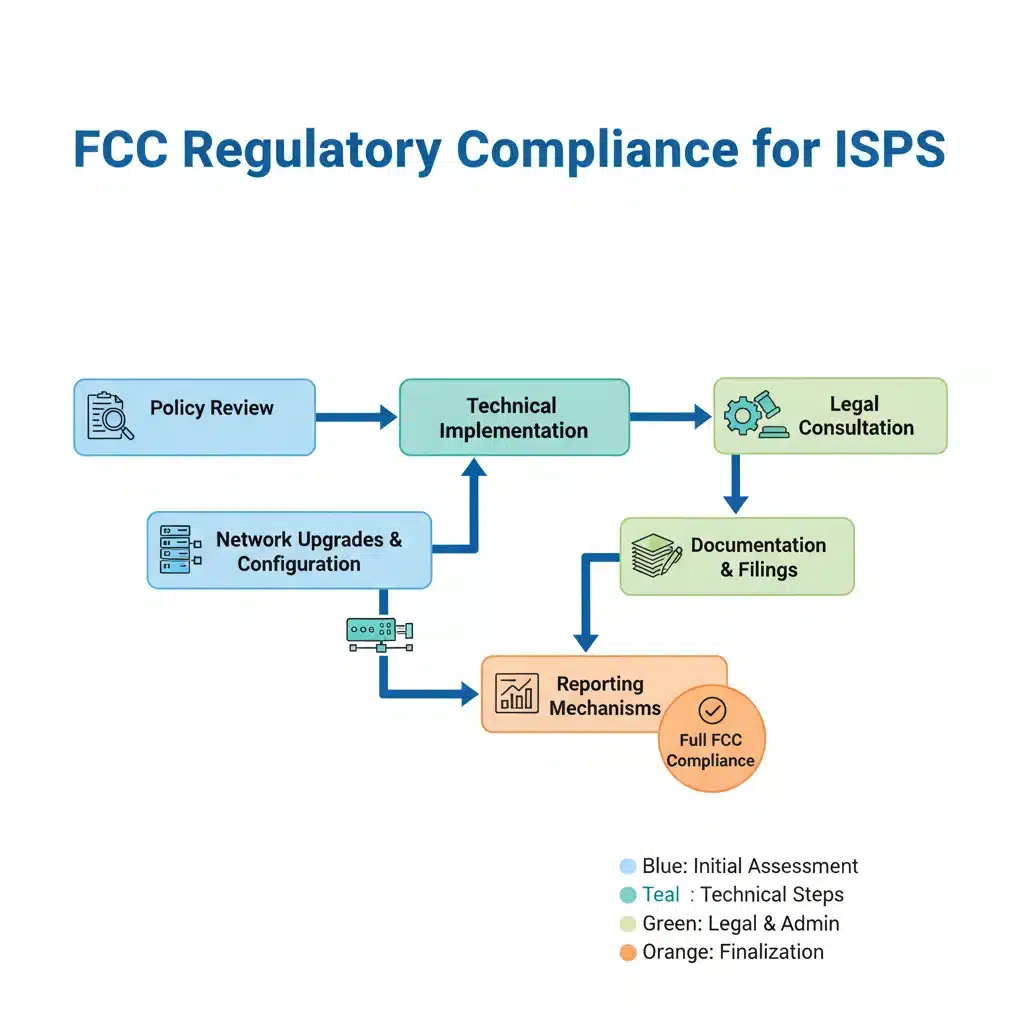
The March 2026 deadline for implementing the new FCC Net Neutrality rules may seem distant, but the scope of changes required demands immediate and sustained effort from US ISPs. A structured, multi-faceted approach is crucial for successful compliance.
1. Conduct a Comprehensive Internal Audit
The first step is to thoroughly audit all existing network management practices, service agreements, and business models. This audit should identify any practices that could be construed as blocking, throttling, or paid prioritization. Examine all peering and interconnection agreements, data caps, and any policies related to specific applications or content. This internal review should involve cross-functional teams, including engineering, legal, marketing, and customer service.
2. Review and Update Network Infrastructure and Software
Based on the audit findings, ISPs may need to make significant adjustments to their network infrastructure and software. This could involve reconfiguring routers, switches, and traffic management systems to ensure neutrality. Invest in technologies that allow for non-discriminatory congestion management, such as smart queuing algorithms that treat all traffic equally, rather than prioritizing certain types. Prioritize upgrades that enhance overall network capacity to reduce the temptation for discriminatory practices.
3. Legal and Regulatory Consultation
Engage with experienced legal counsel specializing in telecommunications law. They can provide invaluable guidance on interpreting the new FCC Net Neutrality rules, drafting compliant terms of service, and responding to potential FCC inquiries. Legal experts can also help in preparing for potential enforcement actions and navigating any ambiguities in the regulations. This is not a one-time consultation but an ongoing partnership throughout the transition period.
4. Enhance Transparency and Disclosure Practices
Revamp your transparency disclosures to meet the expected stricter requirements. This includes clearly outlining network management practices, typical speeds, latency, and packet loss on your website and in customer contracts. Ensure that these disclosures are easy to understand for the average consumer, avoiding overly technical jargon. Consider creating dedicated sections on your website to address net neutrality compliance and answer common customer questions.
5. Re-evaluate Business Models and Partnerships
Scrutinize any existing partnerships or business arrangements that involve preferential treatment of content or applications. This includes zero-rating programs or any agreements where content providers pay for enhanced delivery. Develop new business strategies that align with net neutrality principles, focusing on providing high-quality, open internet access to all customers. Explore value-added services that are compliant, such as advanced security features or parental controls, rather than traffic-shaping incentives.
6. Employee Training and Awareness
Implement comprehensive training programs for all employees, from engineering and sales to customer service. Ensure that everyone understands the core principles of FCC Net Neutrality and how these rules impact their daily responsibilities. Employees should be aware of what constitutes a violation and how to report potential issues internally. A culture of compliance starts with informed personnel.
7. Establish Robust Monitoring and Reporting Mechanisms
Set up internal systems to continuously monitor network performance and ensure ongoing compliance. This includes logging network management activities and regularly auditing traffic patterns. Be prepared to respond to FCC data requests and demonstrate compliance through clear, verifiable data. Consider independent third-party audits to validate your compliance efforts and provide an extra layer of assurance.
8. Engage with Industry Groups and the FCC
Stay informed about any further clarifications or amendments to the rules by actively participating in industry associations and engaging with the FCC. Provide feedback during public comment periods, where appropriate, to help shape the final implementation guidelines. Being part of the conversation can help ISPs anticipate changes and prepare more effectively.
By systematically addressing these areas, US ISPs can build a strong foundation for compliance with the new FCC Net Neutrality rules by March 2026, ensuring operational continuity and maintaining customer trust.
Potential Challenges and Legal Landscape for ISPs
While the FCC is moving to reinstate FCC Net Neutrality, the road ahead for US ISPs is unlikely to be entirely smooth. Several potential challenges and legal considerations could arise, necessitating careful navigation.
Renewed Legal Challenges
The history of FCC Net Neutrality is replete with legal battles, and the re-establishment of Title II authority is almost certainly going to face renewed challenges in the courts. Industry groups and individual ISPs that oppose the rules may file lawsuits, arguing that the FCC has exceeded its statutory authority or that the rules are arbitrary and capricious. These challenges could create uncertainty and potentially delay full implementation or lead to further modifications. ISPs should monitor these legal developments closely and understand their potential implications.
State vs. Federal Authority
During the period when federal net neutrality protections were absent, several states enacted their own net neutrality laws. The re-establishment of federal rules raises questions about preemption – whether federal law will supersede state laws. While the FCC’s action aims to create a uniform national standard, the interplay between state and federal regulations could become a point of contention and legal complexity for ISPs operating across multiple jurisdictions. ISPs will need to understand which regulations apply and how to reconcile any discrepancies.
Defining ‘Reasonable Network Management’
The rules typically allow for ‘reasonable network management’ practices that are necessary for network security, reliability, and preventing congestion. However, the definition of ‘reasonable’ can be subjective and a source of dispute. ISPs will need to meticulously document and justify any network management practices to demonstrate they are narrowly tailored, non-discriminatory, and not a pretext for blocking, throttling, or paid prioritization. The FCC will likely provide guidance, but interpretations may still vary, leading to potential enforcement actions.

Enforcement and Penalties
Under Title II, the FCC gains robust enforcement powers, including the ability to issue substantial fines for violations. ISPs could face penalties for non-compliance with blocking, throttling, paid prioritization, and transparency rules. The threat of regulatory action and financial penalties underscores the importance of a robust compliance program. ISPs must have clear internal policies, training, and monitoring to mitigate these risks.
Technological Evolution and Future-Proofing
The internet is constantly evolving, with new technologies and services emerging regularly. The FCC Net Neutrality rules, while designed to be technologically neutral, may face challenges in adapting to future innovations. ISPs will need to ensure that their compliance strategies are flexible enough to accommodate new network technologies (e.g., 5G, satellite internet) and internet applications without inadvertently violating the rules. This requires a forward-thinking approach to network design and policy development.
Public and Political Scrutiny
Net neutrality remains a highly politicized issue. ISPs will continue to operate under significant public and political scrutiny. Consumer advocacy groups will be vigilant in reporting perceived violations, and lawmakers may hold hearings or introduce legislation related to internet regulation. Maintaining a transparent and compliant operation is not just a legal necessity but also a public relations imperative.
Despite these potential hurdles, a proactive and well-informed approach will allow US ISPs to navigate the complex legal and regulatory landscape effectively, ensuring their operations remain compliant and resilient in the face of evolving FCC Net Neutrality rules.
Conclusion: Embracing the Future of an Open Internet
The re-establishment of FCC Net Neutrality rules marks a significant chapter in the ongoing saga of internet regulation in the United States. For US ISPs, the March 2026 deadline is not merely a date on the calendar; it represents a critical juncture that demands meticulous preparation, strategic adaptation, and an unwavering commitment to the principles of an open internet.
The shift back to Title II classification for broadband internet access service fundamentally alters the regulatory framework, placing ISPs under common carrier obligations. This means strict prohibitions against blocking, throttling, and paid prioritization, coupled with enhanced transparency requirements and renewed consumer privacy protections. While some ISPs may view these regulations as an imposition, they also present an opportunity to reinforce trust with consumers and contribute to a more equitable digital landscape.
Successfully navigating this transition requires a proactive and comprehensive strategy. ISPs must undertake thorough internal audits, invest in necessary network infrastructure upgrades, engage expert legal counsel, and overhaul their business models to align with the new regulatory realities. Employee training, robust monitoring systems, and transparent communication with customers will be paramount in demonstrating compliance and fostering a positive public image.
While potential legal challenges and the complexities of defining ‘reasonable network management’ may create uncertainties, a well-prepared ISP can mitigate these risks. By staying informed, actively participating in industry discussions, and embracing the spirit of an open internet, ISPs can not only meet the compliance deadline but also thrive in an environment where fair and equal access to information is prioritized.
The future of the internet in the US is poised to be one where innovation flourishes on a level playing field, and consumers have unrestricted access to the vast resources of the digital world. By embracing the new FCC Net Neutrality rules, US ISPs can play a pivotal role in shaping this future, ensuring that the internet remains a powerful engine for economic growth, social connection, and democratic participation for all.