Subscription Fatigue: Why 30% of US Consumers Are Re-evaluating Services by 2026

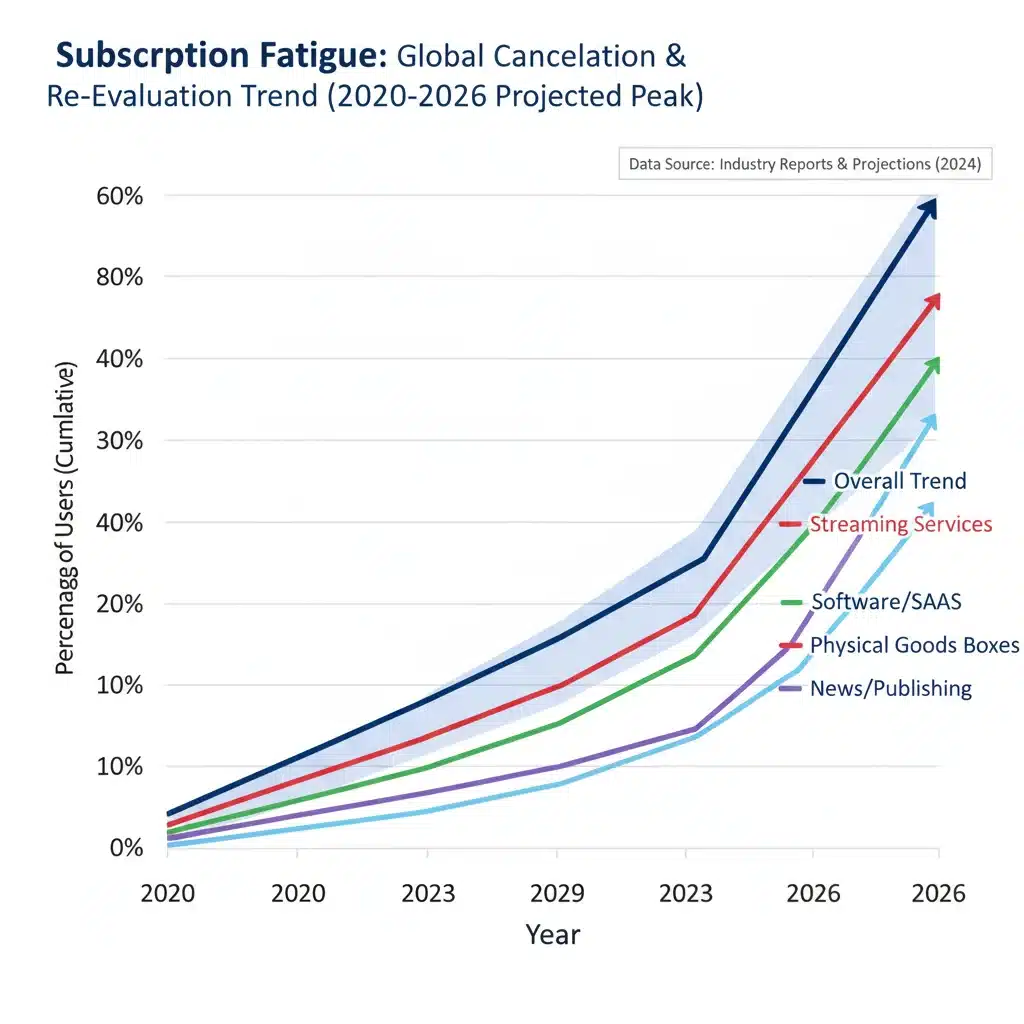
The digital age has ushered in an era of unprecedented convenience, with subscription services becoming an integral part of our daily lives. From streaming entertainment and fitness apps to software tools and curated product boxes, the subscription economy has boomed. However, this proliferation of choices is now leading to a new, pervasive phenomenon: subscription fatigue US. A recent projection indicates that a staggering 30% of US consumers will actively re-evaluate their subscription services by 2026. This isn’t just a minor blip; it’s a significant shift in consumer behavior that demands attention from businesses across all sectors.
For years, the subscription model was hailed as the holy grail of recurring revenue, offering predictable income streams and fostering deep customer relationships. Companies rushed to adopt this model, often without fully considering the long-term implications for consumers. Now, as bank statements fill with a dizzying array of monthly charges, consumers are hitting a wall. The initial excitement of access has given way to a feeling of being overwhelmed, overcharged, and underserved. This article delves deep into the causes of subscription fatigue US, explores its far-reaching impacts, and outlines actionable strategies for businesses to not only survive but thrive in this evolving landscape.
The Ubiquity of Subscriptions: A Double-Edged Sword
The rise of the subscription economy is undeniable. Consumers now subscribe to everything from coffee beans and meal kits to cloud storage and premium news content. The appeal is clear: convenience, personalization, and often, a lower upfront cost compared to outright ownership. For businesses, subscriptions offer stable revenue, opportunities for upselling, and valuable data for product development and marketing. However, this very ubiquity is a primary driver of subscription fatigue US.
Consider the average household. A typical family might have subscriptions for Netflix, Hulu, Spotify, Amazon Prime, a fitness app, a software suite for work, a gaming service, and perhaps a niche content platform. Each of these services, while individually affordable, collectively adds up to a substantial monthly expenditure. The sheer volume creates a cognitive load; consumers struggle to keep track of what they have, when payments are due, and whether they are truly utilizing each service to its full potential.
This oversaturation leads to a sense of being perpetually subscribed, often to services that are rarely used but continue to incur charges. The ‘set it and forget it’ mentality, once a boon for subscription providers, is now turning into a liability as consumers become more vigilant about their spending and digital footprint. The convenience that initially attracted them is now overshadowed by a feeling of being locked in and financially drained.
Understanding the Drivers of Subscription Fatigue in the US
Several key factors contribute to the growing wave of subscription fatigue US. Identifying these drivers is crucial for businesses looking to retain their subscribers and attract new ones in a competitive market.
1. Cost Overload and Budget Constraints
The most obvious factor is the cumulative cost. While individual subscriptions might seem inexpensive, the total monthly outlay can be significant. In an economic climate characterized by inflation and rising living costs, consumers are becoming increasingly budget-conscious. They are scrutinizing their expenses more closely than ever, and subscriptions, being discretionary spending for many, are often the first to be cut or re-evaluated. The ‘death by a thousand cuts’ phenomenon, where numerous small charges add up to a large sum, is a major trigger for consumers to address their subscription habits.
2. Underutilization and Perceived Value Gap
Many consumers sign up for a service with good intentions, only to find they don’t use it as much as they anticipated. A gym membership app, a premium news subscription, or a specialized streaming service might sit dormant for weeks or months, yet the monthly charge persists. This creates a significant gap between the perceived value at the point of purchase and the actual value derived from usage. When consumers realize they are paying for something they barely use, it fuels frustration and leads to cancellations. The perceived value must consistently outweigh the cost for a subscription to remain viable in the long term.
3. Content and Feature Overlap
The competitive nature of the subscription market often leads to content and feature overlap. Multiple streaming services offer similar genres or even the same shows through different licensing agreements. Various productivity apps provide comparable functionalities. Consumers find themselves paying for redundant services, leading to inefficiency and wasted money. This overlap contributes to the feeling of being over-subscribed and prompts consumers to consolidate their services, choosing one over many similar offerings.
4. Management Complexity and ‘Ghost’ Subscriptions
Keeping track of multiple subscriptions, their billing cycles, and cancellation policies can be a logistical nightmare. Many consumers forget about subscriptions they signed up for, leading to ‘ghost’ subscriptions that silently drain their bank accounts. The process of canceling can also be intentionally convoluted, adding to consumer frustration. This management complexity is a significant contributor to subscription fatigue US, as consumers seek simpler, more transparent ways to manage their digital lives.
5. Shifting Consumer Priorities
Consumer priorities are constantly evolving. What was essential last year might be considered a luxury today. Life events, economic changes, and personal preferences all play a role in how consumers value their subscriptions. The pandemic, for instance, saw a surge in streaming and home-based fitness subscriptions. As life returns to a new normal, these priorities are shifting again, prompting a re-evaluation of services that once seemed indispensable.
The Impact of Subscription Fatigue on Businesses
The projected 30% of US consumers re-evaluating their subscriptions by 2026 is not merely a statistic; it represents a significant challenge and opportunity for businesses. The impacts will be felt across various aspects of the subscription economy.
Increased Churn Rates
The most immediate and direct impact will be an increase in churn rates. As consumers become more selective, they will actively cancel services they deem unnecessary or underutilized. This will put immense pressure on companies to demonstrate continuous value and engage their subscribers effectively. Businesses that fail to adapt will see their customer base erode, impacting revenue and growth projections.
Pressure on Pricing Models
Subscription fatigue US will inevitably lead to increased price sensitivity. Consumers will be less willing to tolerate price increases and more likely to seek out cheaper alternatives or free versions of services. This will force businesses to re-evaluate their pricing strategies, potentially leading to more tiered options, ad-supported models, or even a return to transactional purchases for certain content or features. The era of simply adding another dollar to the monthly fee without a clear increase in value is likely coming to an end.
Demand for Greater Flexibility and Transparency
Consumers will demand more flexibility in their subscriptions, such as easier pausing or cancellation options, and the ability to switch between tiers without hassle. Transparency regarding billing cycles, usage data, and how personal information is used will also become paramount. Companies that offer opaque terms or make cancellations difficult will face significant backlash and customer exodus.
Shift Towards Bundling and Aggregation
To combat the complexity of managing multiple subscriptions, consumers may gravitate towards bundled offerings or aggregator platforms. This could involve telecommunication companies offering packages that include streaming services, or new platforms emerging that allow users to manage all their subscriptions in one place. Businesses might need to consider strategic partnerships or integrate into larger ecosystems to remain competitive and visible.
Emphasis on Customer Experience and Engagement
In a saturated market, customer experience will be the ultimate differentiator. Companies will need to invest heavily in understanding their users, personalizing their offerings, and providing exceptional support. Proactive engagement, such as reminding users of unused features or personalized content recommendations, will be crucial in demonstrating ongoing value and combating the ‘set it and forget it’ mentality that leads to churn.
Strategies for Businesses to Combat Subscription Fatigue
Navigating the challenges of subscription fatigue US requires a proactive and customer-centric approach. Businesses need to innovate and adapt to retain their existing subscribers and attract new ones.
1. Focus on Delivering Consistent, Measurable Value
The fundamental principle for combating fatigue is to continuously deliver value that justifies the cost. This means going beyond initial sign-up perks and consistently updating content, adding new features, or improving the user experience. Businesses should regularly communicate the value proposition to their subscribers, highlighting new additions and demonstrating how the service enhances their lives. Metrics like active usage, feature adoption, and customer satisfaction surveys can help gauge perceived value.
2. Optimize Pricing and Offer Flexible Plans
Rigid pricing models are a recipe for churn. Businesses should explore tiered pricing structures that cater to different usage levels and budgets. Consider offering annual plans at a discount to encourage longer commitments, or short-term, project-based subscriptions for specific needs. The ability to pause subscriptions temporarily, rather than outright cancel, can be a powerful retention tool. Freemium models, where basic features are free and advanced ones are paid, can also help users experience value before committing financially.
3. Enhance User Experience and Personalization
A seamless, intuitive user experience is no longer a luxury but a necessity. Invest in user-friendly interfaces, robust search functionalities, and personalized recommendations. Leverage data to understand individual user preferences and tailor content or product suggestions. The more personalized and effortless the experience, the higher the perceived value and the less likely a subscriber is to feel fatigued.
4. Improve Transparency and Simplify Management
Make it incredibly easy for subscribers to view their billing history, understand their usage, and manage their subscriptions. Implement clear, straightforward cancellation processes. Avoid hidden fees or confusing terms. Consider developing a centralized dashboard where users can see all their subscriptions, payment dates, and usage statistics. Tools that send reminders before renewals or offer insights into usage can empower consumers and build trust.
5. Foster Community and Engagement
Beyond the core service, build a community around your brand. This could involve forums, exclusive events, or social media groups where subscribers can connect and share their experiences. Engaged communities create a sense of belonging and add an extra layer of value that goes beyond the transactional aspects of the subscription. Loyalty programs that reward long-term subscribers can also be highly effective.
6. Strategic Partnerships and Bundling Opportunities
Explore opportunities to partner with complementary services. For example, a fitness app might partner with a healthy meal delivery service. Offering bundled packages can increase the overall value proposition for consumers and reduce the likelihood of them seeking out individual services. This also helps in reducing the mental load of managing multiple separate subscriptions.
7. Proactive Churn Prevention
Don’t wait for subscribers to cancel. Implement predictive analytics to identify users at risk of churning. This could involve monitoring declining engagement, unread emails, or changes in usage patterns. Once identified, proactively reach out with personalized offers, usage tips, or surveys to understand their concerns and address them before they decide to leave. Exit surveys, when a cancellation does occur, are invaluable for gathering feedback and improving services.

The Future of the Subscription Economy Amidst Fatigue
The projection that 30% of US consumers will re-evaluate their subscriptions by 2026 signals a maturation of the subscription market. It’s not a death knell for the subscription economy, but rather a necessary recalibration. The initial land grab for subscribers is over; the focus is now shifting towards sustainable growth through retention and genuine value delivery. Companies that embrace this shift will be the ones that thrive.
The future likely holds a more curated and consolidated subscription landscape. Consumers will become even more discerning, opting for fewer, higher-quality services that truly meet their needs and deliver consistent value. This means businesses must move away from a ‘collect as many subscribers as possible’ mindset to a ‘cherish and nurture each subscriber’ approach. The emphasis will be on building lasting relationships based on trust, transparency, and undeniable value.
Furthermore, we may see the emergence of innovative business models that blend subscription with other forms of consumption. For instance, hybrid models that offer a basic subscription with options for pay-per-use premium content, or ‘rent-to-own’ models for physical goods. The key will be flexibility and adaptability to evolving consumer demands. The companies that listen to their customers and respond with creative solutions will be the ones that overcome subscription fatigue US and emerge stronger.
Conclusion
Subscription fatigue US is a growing reality that businesses can no longer ignore. With 30% of US consumers poised to re-evaluate their services by 2026, the subscription economy is entering a critical phase. The era of simply accumulating subscriptions is giving way to a demand for meaningful engagement, transparent pricing, and undeniable value.
For businesses, this presents both a challenge and a profound opportunity. Those that proactively address the drivers of fatigue – cost overload, underutilization, content overlap, and management complexity – by focusing on customer-centric strategies will be well-positioned for future success. Delivering consistent value, offering flexible pricing, enhancing user experience, and fostering genuine engagement are not just best practices; they are essential survival strategies in this evolving market.
The subscription model is not disappearing, but it is undoubtedly maturing. The companies that understand this shift and adapt their offerings to meet the sophisticated demands of the modern consumer will be the ones that continue to prosper, building loyal customer bases that see their subscriptions not as a burden, but as an indispensable part of their lives.