Maximizing ROI with Edge Computing: A 15% Performance Boost for US Manufacturers by 2027
Maximizing ROI with Edge Computing: A 15% Performance Boost for US Manufacturers by 2027
The landscape of US manufacturing is undergoing a profound transformation, driven by relentless innovation and the imperative to stay competitive in a globalized market. At the forefront of this revolution is Edge Computing ROI, a technology poised to deliver unprecedented performance enhancements and significant returns on investment. As we look towards 2027, the promise of a 15% performance boost for US manufacturers through strategic adoption of edge computing is not merely an aspiration but a tangible goal within reach.
In an era where data is the new oil, the ability to process, analyze, and act upon information at the source, rather than relying solely on centralized cloud infrastructure, offers a distinct competitive advantage. This is precisely what edge computing enables. By bringing computational power closer to the data generation points – be it on the factory floor, in remote facilities, or within smart devices – manufacturers can achieve real-time insights, optimize operations, reduce latency, and enhance security. The implications for maximizing Edge Computing ROI are vast and far-reaching, touching every facet of the manufacturing value chain.
This comprehensive guide will delve into the critical aspects of edge computing for US manufacturers, exploring how this technology can drive efficiency, foster innovation, and ultimately deliver a substantial return on investment. We will examine the core principles of edge computing, its diverse applications within manufacturing, the challenges associated with its implementation, and the strategic pathways to unlock its full potential, ensuring that the ambitious target of a 15% performance boost by 2027 becomes a reality.
Understanding Edge Computing: The Foundation of Future Manufacturing
Before we can fully appreciate the impact on Edge Computing ROI, it’s essential to grasp what edge computing entails. In its simplest form, edge computing is a distributed computing paradigm that brings computation and data storage closer to the sources of data. This contrasts with traditional cloud computing models, where data is transmitted to a central data center for processing. For manufacturing environments, where milliseconds can translate into significant operational differences, this proximity is a game-changer.
The Core Principles of Edge Computing
- Proximity: Data processing occurs near the data source, minimizing latency and enabling real-time decision-making.
- Autonomy: Edge devices can operate independently, even with intermittent network connectivity to the cloud, ensuring continuous operation.
- Security: Processing data locally reduces the amount of sensitive information transmitted over networks, enhancing data security and compliance.
- Efficiency: By filtering and processing data at the edge, only relevant information is sent to the cloud, reducing bandwidth consumption and storage costs.
The architecture of edge computing typically involves a hierarchy of devices, from sensors and actuators at the very edge (the ‘far edge’) to industrial gateways and micro-data centers (the ‘near edge’), all connected to a centralized cloud infrastructure. This tiered approach allows for flexible and scalable deployment, tailored to the specific needs of a manufacturing operation. The strategic deployment of these components is crucial for optimizing Edge Computing ROI.
Why Edge Computing Matters for US Manufacturing
US manufacturers face unique challenges, including rising labor costs, intense global competition, and the need for higher product quality and customization. Edge computing offers a powerful solution to address these challenges by enabling:
- Real-time Analytics: Instant insights from production lines allow for immediate adjustments, preventing costly downtime and defects.
- Predictive Maintenance: Sensors at the edge can monitor equipment health, predicting failures before they occur, thereby extending asset lifespan and reducing maintenance costs.
- Enhanced Automation: Autonomous robots and machinery can make decisions faster, improving efficiency and safety on the factory floor.
- Improved Quality Control: Real-time inspection and defect detection systems can identify issues instantly, ensuring consistent product quality.
- Optimized Supply Chains: Edge devices can track inventory and logistics in real-time, leading to more efficient supply chain management.
Each of these benefits directly contributes to a stronger financial position and a higher Edge Computing ROI for manufacturers. The ability to react instantaneously to changing conditions, whether it’s a machine anomaly or a shift in demand, empowers manufacturers to maintain agility and resilience.
The Path to a 15% Performance Boost: Key Applications and Strategies
Achieving a 15% performance boost by 2027 is an ambitious yet attainable goal for US manufacturers leveraging edge computing. This boost will manifest in various forms: increased operational efficiency, reduced waste, improved product quality, faster time-to-market, and enhanced worker safety. The key lies in identifying the most impactful applications and implementing a strategic deployment plan.
Operational Efficiency Through Real-time Data Processing
One of the most immediate and significant contributions of edge computing to Edge Computing ROI is its ability to enhance operational efficiency. Traditional manufacturing processes often involve batch processing of data, leading to delays in identifying and resolving issues. Edge computing, however, shifts this paradigm by enabling real-time data analysis at the source.
- Machine Monitoring and Optimization: Sensors on manufacturing equipment collect vast amounts of data on temperature, vibration, pressure, and output. Edge devices can process this data locally to identify anomalies, predict potential failures, and optimize machine parameters for maximum efficiency and throughput. This proactive approach minimizes unexpected downtime, a major drag on productivity and profitability.
- Process Control and Automation: In highly automated environments, edge computing allows for closed-loop control systems to operate with minimal latency. Robots and automated guided vehicles (AGVs) can make decisions and adjust their actions based on immediate feedback from their surroundings, leading to smoother operations, fewer errors, and increased production speed.
- Energy Management: Edge devices can monitor energy consumption across different machines and processes in real-time. By analyzing this data at the edge, manufacturers can identify energy waste, optimize power usage, and implement dynamic energy management strategies, leading to substantial cost savings and a greener footprint.
These applications directly translate into a more streamlined, efficient, and cost-effective manufacturing operation, forming the bedrock of a strong Edge Computing ROI.
Predictive Maintenance: From Reactive to Proactive
The shift from reactive to proactive maintenance is a cornerstone of modern manufacturing excellence and a significant driver of Edge Computing ROI. Historically, maintenance was performed either on a fixed schedule or in response to a breakdown. Both approaches are inefficient: scheduled maintenance can lead to unnecessary interventions, while reactive maintenance results in costly downtime and potential safety hazards.
Edge computing, combined with machine learning algorithms, enables highly effective predictive maintenance programs. Sensors on critical machinery continuously collect data points such as vibration, temperature, acoustic signatures, and current draw. Edge devices analyze this data in real-time, identifying subtle patterns that indicate impending equipment failure. This allows maintenance teams to intervene precisely when needed, before a catastrophic breakdown occurs.
- Reduced Downtime: By scheduling maintenance proactively, manufacturers can minimize unplanned outages, ensuring continuous production.
- Extended Asset Lifespan: Addressing issues before they escalate prolongs the life of valuable machinery, deferring capital expenditures.
- Optimized Maintenance Costs: Maintenance efforts are focused only on machines that require attention, reducing labor and spare parts costs.
- Enhanced Safety: Preventing equipment failures also reduces the risk of accidents on the factory floor.
The financial impact of predictive maintenance, powered by edge computing, is substantial, making it a key factor in realizing the targeted 15% performance increase.

Quality Control and Defect Detection
Maintaining high product quality is paramount for brand reputation and customer satisfaction. Edge computing significantly enhances quality control processes by enabling real-time inspection and defect detection, directly impacting Edge Computing ROI by reducing rework and scrap.
High-resolution cameras and other sensors, integrated with edge devices, can monitor products as they move along the production line. Edge AI algorithms can analyze images and sensor data instantaneously to identify defects, inconsistencies, or deviations from quality standards. If a defect is detected, the system can immediately flag the product, alert operators, or even trigger automated corrective actions.
- Instant Feedback: Defects are identified as they occur, preventing the production of large batches of faulty goods.
- Reduced Waste: Minimizing defective products leads to less material waste and lower rework costs.
- Consistent Quality: Automated inspection systems provide objective and consistent quality checks, surpassing human capabilities for repetitive tasks.
- Root Cause Analysis: Real-time data on defects can be used to pinpoint the root causes of quality issues, allowing for proactive process adjustments.
By ensuring product quality at every stage, edge computing helps manufacturers avoid costly recalls, protect their brand image, and ultimately improve their bottom line.
Overcoming Challenges and Ensuring Successful Implementation
While the benefits of edge computing are clear, its successful implementation in manufacturing environments is not without challenges. Addressing these challenges proactively is crucial for maximizing Edge Computing ROI.
Key Challenges
- Integration Complexity: Integrating new edge systems with existing legacy infrastructure can be complex and require careful planning.
- Data Security and Privacy: While edge computing can enhance security by localizing data, it also introduces new attack vectors that need to be secured.
- Connectivity and Network Infrastructure: Reliable and robust network connectivity is essential for data transmission between edge devices and the cloud.
- Skill Gap: Manufacturers may lack the in-house expertise to deploy, manage, and maintain edge computing solutions.
- Scalability: Designing an edge infrastructure that can scale with evolving operational needs is critical.
Strategies for Successful Deployment
- Phased Implementation: Start with pilot projects in specific areas to demonstrate value and gain experience before scaling across the entire operation.
- Hybrid Cloud Strategy: Adopt a hybrid approach that leverages both edge and cloud computing, optimizing where data is processed and stored based on latency, security, and cost requirements.
- Robust Security Protocols: Implement end-to-end security measures, including encryption, access control, and threat detection, to protect edge devices and data.
- Strategic Partnerships: Collaborate with technology providers and system integrators who specialize in industrial edge computing to leverage their expertise and accelerate deployment.
- Workforce Training: Invest in training programs for employees to develop the necessary skills for managing and utilizing edge computing technologies.
By systematically addressing these challenges, US manufacturers can pave the way for a smooth transition to an edge-enabled future and ensure a strong Edge Computing ROI.
The Economic Impact: Quantifying the 15% Performance Boost
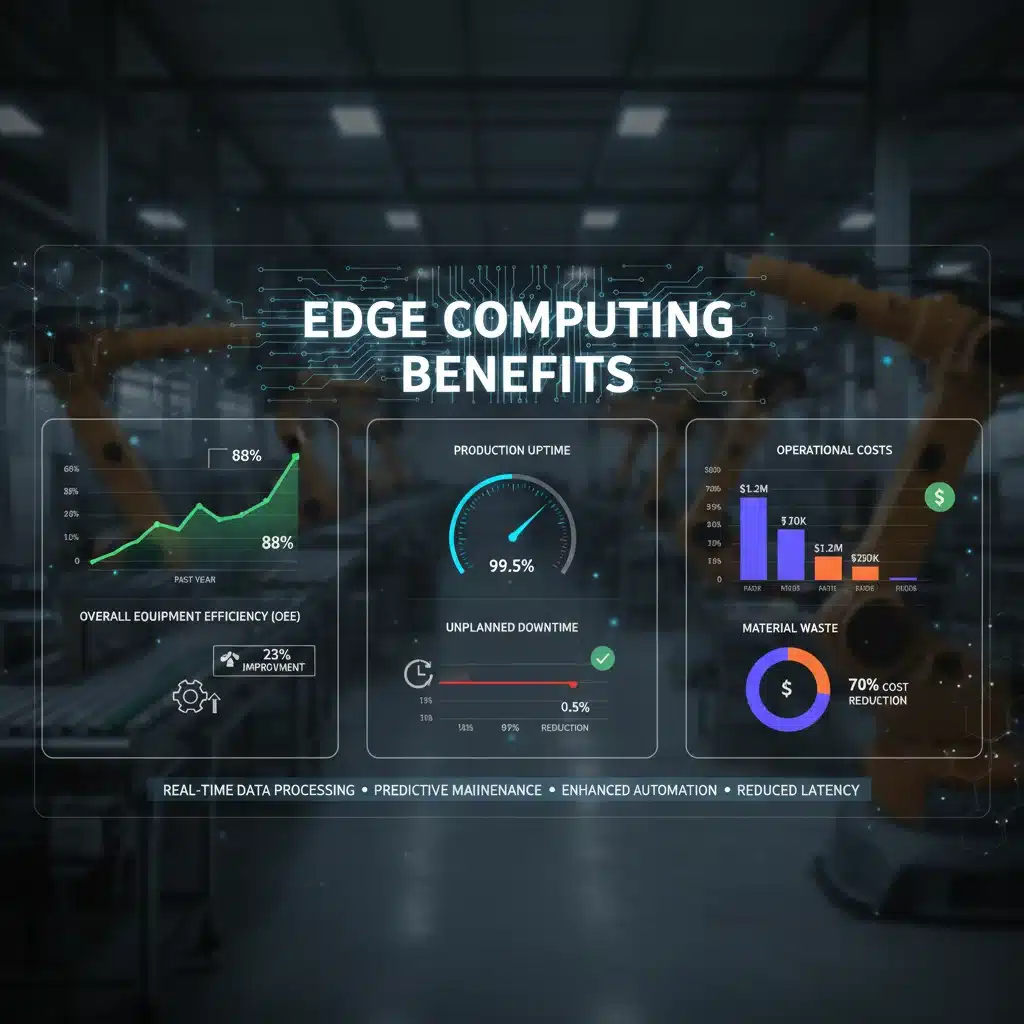
The target of a 15% performance boost by 2027 is a significant one, and it’s important to understand how this translates into tangible economic benefits and Edge Computing ROI for US manufacturers. This performance boost is not a single metric but an aggregate of improvements across various operational areas.
Key Metrics Contributing to the Performance Boost
- Reduced Operational Costs: This includes savings from optimized energy consumption, reduced maintenance expenses, and minimized waste from defects. For a typical manufacturing plant, even a small percentage reduction in these areas can lead to millions of dollars in annual savings.
- Increased Throughput and Production Capacity: By minimizing downtime, optimizing machine performance, and streamlining processes, manufacturers can produce more goods in the same amount of time, or even reduce production cycles.
- Improved Asset Utilization: Edge computing helps ensure that machinery and equipment are used to their fullest potential, extending their lifespan and delaying the need for new capital investments.
- Enhanced Product Quality and Customer Satisfaction: Fewer defects and higher quality products lead to less rework, fewer returns, and a stronger brand reputation, which can translate into increased sales and customer loyalty.
- Faster Time-to-Market: Streamlined production processes and real-time insights can accelerate product development and introduction, giving manufacturers a competitive edge.
Consider a manufacturing facility with an annual revenue of $100 million. A 15% performance boost could translate into several million dollars in increased profitability, either through cost reductions, revenue growth, or a combination of both. This level of impact makes the investment in edge computing not just justifiable, but essential for long-term growth and competitiveness.
Case Studies and Industry Trends
While specific figures vary, early adopters of edge computing in manufacturing are already reporting impressive results. For instance, some companies have seen a 20-30% reduction in unplanned downtime due to predictive maintenance, while others have achieved significant energy savings. The market for industrial edge computing is projected to grow substantially, indicating a widespread recognition of its value.
Reports from industry analysts consistently highlight edge computing as a top priority for digital transformation in manufacturing. The convergence of 5G networks, artificial intelligence, and the Internet of Things (IoT) further amplifies the capabilities of edge computing, creating a powerful ecosystem for innovation and efficiency. This evolving technological landscape provides a fertile ground for maximizing Edge Computing ROI.
The Future of Manufacturing: Edge Computing as a Strategic Imperative
As we move closer to 2027 and beyond, edge computing will cease to be a ‘nice-to-have’ technology and will become a strategic imperative for US manufacturers aiming to remain competitive and achieve sustainable growth. The ability to harness the power of data at the edge will define the leaders in the next era of industrial innovation.
Integration with Advanced Technologies
The true power of edge computing is unlocked when it is integrated with other advanced technologies:
- Artificial Intelligence (AI) and Machine Learning (ML): Edge devices can host AI/ML models, enabling real-time inference and decision-making directly on the factory floor, without constant reliance on cloud connectivity. This is critical for applications like real-time quality inspection and autonomous robotics.
- 5G Connectivity: The low latency and high bandwidth of 5G networks provide the ideal backbone for connecting a vast array of edge devices, enabling seamless data flow and communication.
- Digital Twins: Edge computing feeds real-time data into digital twin models, creating highly accurate virtual representations of physical assets and processes. This allows for simulation, optimization, and predictive analysis with unparalleled precision.
- Augmented Reality (AR) and Virtual Reality (VR): Edge devices can process data for AR/VR applications, assisting technicians with maintenance, training, and operational guidance in real-time.
These synergistic technologies amplify the benefits of edge computing, further solidifying its role in driving a higher Edge Computing ROI.
Sustainability and Environmental Impact
Beyond economic gains, edge computing also contributes to a more sustainable manufacturing future. By optimizing resource usage, reducing waste, and improving energy efficiency, manufacturers can significantly lower their environmental footprint. Real-time monitoring of emissions and waste streams can help companies meet regulatory requirements and achieve their sustainability goals, which is increasingly important for corporate social responsibility and brand image.
Workforce Empowerment and Safety
Edge computing not only automates tasks but also empowers the human workforce. By providing real-time insights and automating repetitive or dangerous tasks, it allows employees to focus on higher-value activities that require critical thinking and problem-solving. Furthermore, real-time monitoring of hazardous environments and equipment can significantly enhance worker safety, preventing accidents and creating a healthier work environment.
Conclusion: Embracing the Edge for a Competitive Future
The journey towards a 15% performance boost for US manufacturers by 2027, driven by edge computing, is a testament to the transformative power of technology. The ability to process data at the source offers unparalleled opportunities for operational efficiency, predictive maintenance, enhanced quality control, and accelerated innovation. While challenges exist, the strategic implementation of edge computing, coupled with a clear understanding of its multifaceted benefits, positions manufacturers for a future of sustained growth and competitiveness.
For US manufacturers, the time to embrace edge computing is now. By investing in this critical technology, they are not just upgrading their infrastructure; they are investing in their future, ensuring they remain at the vanguard of industrial innovation and continue to drive economic prosperity. The promise of a significant Edge Computing ROI is not just a theoretical concept, but a quantifiable reality that will redefine manufacturing excellence in the years to come.