AI Ethics Frameworks: Essential for US Tech Compliance by Q2 2026

The rapid evolution of Artificial Intelligence (AI) has brought unprecedented innovation and transformative capabilities across industries. However, this technological leap also ushers in a complex array of ethical dilemmas and societal concerns. From algorithmic bias and data privacy to accountability and transparency, the ethical implications of AI are profound and far-reaching. As AI systems become increasingly integrated into the fabric of daily life and critical infrastructure, the need for robust ethical guidelines has never been more urgent. Governments, regulatory bodies, and the public are demanding greater responsibility from tech companies developing and deploying these powerful tools.
In the United States, the landscape for AI regulation is rapidly crystalizing. While a single, comprehensive federal law similar to Europe’s AI Act is still under development, a patchwork of executive orders, proposed legislation, and industry-specific guidelines is forming a clear expectation for US tech companies. The impending deadline of Q2 2026 for the adoption of critical AI Ethics Frameworks is not merely a suggestion; it represents a pivotal moment for compliance, risk mitigation, and the sustained growth of the AI sector. Companies that fail to proactively embed ethical principles into their AI development lifecycle risk not only significant financial penalties and legal challenges but also irreparable damage to their brand reputation and public trust.
This article delves into the three critical AI Ethics Frameworks that US tech companies must adopt to navigate this complex regulatory environment and ensure compliance by the Q2 2026 deadline. We will explore each framework in detail, outlining its core principles, practical implementation strategies, and the benefits of early adoption. Understanding and integrating these frameworks is no longer an optional endeavor but a strategic imperative for any tech company aiming to thrive in the era of responsible AI.
The Urgency of Adopting AI Ethics Frameworks: Why Q2 2026 is a Critical Juncture
The imperative for US tech companies to adopt comprehensive AI Ethics Frameworks by Q2 2026 stems from a confluence of factors, including increasing regulatory scrutiny, growing public demand for responsible AI, and the inherent risks associated with unchecked AI development. The timeline is not arbitrary; it reflects the accelerating pace of AI deployment and the corresponding rise in documented instances of algorithmic harm, bias, and privacy infringements.
Mounting Regulatory Pressure
While the US doesn’t yet have a unified AI law, several key initiatives signal the direction of future regulation. The Biden administration’s Executive Order on the Safe, Secure, and Trustworthy Development and Use of Artificial Intelligence, issued in October 2023, laid out a broad set of directives for federal agencies, emphasizing safety, security, and the mitigation of bias. This executive order serves as a foundational document, signaling to the industry that self-regulation alone is no longer sufficient. It mandates the development of standards, guidelines, and best practices, effectively setting the stage for future legislative action and enforcement.
Furthermore, individual states are also taking action. California, for instance, has been at the forefront of data privacy with the CCPA and CPRA, and similar legislative efforts are emerging that specifically address AI’s impact on consumer rights and civil liberties. Sector-specific regulations, such as those in healthcare (HIPAA) and finance, are also beginning to incorporate AI-specific provisions, demanding greater scrutiny of AI systems used in these sensitive areas. The confluence of these federal and state-level initiatives creates a complex, yet inescapable, regulatory landscape that necessitates a proactive approach to AI Ethics Frameworks.
Mitigating Reputational and Financial Risks
Beyond regulatory compliance, the adoption of strong AI Ethics Frameworks is crucial for mitigating significant reputational and financial risks. High-profile incidents of AI bias, such as discriminatory hiring algorithms or facial recognition systems with accuracy disparities across demographics, have led to public outcry, boycotts, and severe brand damage. In an increasingly interconnected world, news of unethical AI practices spreads rapidly, eroding consumer trust and alienating stakeholders.
Financially, the costs of non-compliance can be astronomical. Legal battles, class-action lawsuits, and regulatory fines can quickly accumulate, dwarfing the initial investment in ethical AI development. Moreover, companies perceived as unethical may struggle to attract top talent, secure investment, or forge partnerships, all of which are vital for long-term growth and innovation. Adopting robust AI Ethics Frameworks is, therefore, not just about doing the right thing; it’s about safeguarding the company’s future and ensuring its social license to operate.
Fostering Innovation and Trust
Paradoxically, ethical AI is also a powerful driver of innovation. By embedding ethical considerations from the design phase, companies are forced to think more deeply about the societal impact of their technology, leading to more thoughtful, inclusive, and ultimately, more robust and resilient AI systems. Trust is the bedrock of adoption. Consumers and businesses are more likely to embrace AI solutions from companies they perceive as responsible and transparent. Companies with strong AI Ethics Frameworks can differentiate themselves in a crowded market, building a competitive advantage based on trust and responsible innovation.
The Q2 2026 deadline serves as a stark reminder that the time for deliberation is over; the time for decisive action is now. Companies that proactively integrate these frameworks will not only comply with emerging regulations but will also position themselves as leaders in the responsible AI revolution.
Framework 1: The NIST AI Risk Management Framework (AI RMF)
The National Institute of Standards and Technology (NIST) has emerged as a crucial player in the US AI ethics landscape. Its AI Risk Management Framework (AI RMF), published in January 2023, provides a voluntary, but increasingly influential, guide for managing the risks associated with AI. While voluntary, its comprehensive nature and the prestige of NIST mean it is rapidly becoming a de facto standard that US tech companies must consider for their AI Ethics Frameworks.
Core Principles of AI RMF
The AI RMF is structured around four core functions: Govern, Map, Measure, and Manage. These functions are designed to be continuous and iterative, allowing organizations to integrate AI risk management throughout the entire AI lifecycle, from conception to deployment and decommissioning.
- Govern: This function focuses on establishing a culture of AI risk management. It involves defining an organizational approach to AI risk, including policies, procedures, and structures that support the responsible development and use of AI. Key aspects include assigning roles and responsibilities, fostering ethical leadership, and ensuring adequate resources for AI risk management. For US tech companies, this means creating clear internal guidelines and a chain of command for ethical AI decision-making.
- Map: The ‘Map’ function involves identifying and characterizing AI risks. This includes understanding the context of AI use, identifying potential harms (e.g., bias, privacy violations, safety risks), and recognizing the characteristics of the AI system itself. Companies must conduct thorough risk assessments, considering various stakeholders and potential impact scenarios. This is a critical step for any robust AI Ethics Frameworks.
- Measure: Once risks are mapped, the ‘Measure’ function focuses on quantifying, evaluating, and tracking those risks. This involves developing metrics, indicators, and testing methodologies to assess the effectiveness of risk mitigation strategies. It emphasizes the importance of data-driven insights into AI performance, fairness, and transparency. Companies should implement continuous monitoring and auditing mechanisms.
- Manage: The final function, ‘Manage,’ involves prioritizing, responding to, and recovering from AI risks. This includes developing and implementing risk mitigation strategies, establishing incident response plans, and continuously improving AI risk management processes. It also emphasizes communication and transparency with stakeholders about AI risks and mitigation efforts.
Practical Implementation for Tech Companies
Adopting the NIST AI RMF requires a systematic approach:
- Establish an AI Ethics Committee: Create a cross-functional committee responsible for overseeing AI governance, policy development, and risk assessment.
- Integrate AI Risk Assessments: Incorporate AI-specific risk assessments into existing product development lifecycles, identifying potential harms early on.
- Develop AI-Specific Policies: Create clear policies on data provenance, bias detection and mitigation, explainability requirements, and human oversight for AI systems.
- Invest in Tools and Training: Utilize tools for bias detection, explainable AI (XAI), and robust testing. Provide comprehensive training to engineers, data scientists, and product managers on ethical AI principles and the AI RMF.
- Implement Continuous Monitoring: Deploy systems for ongoing monitoring of AI models in production to detect drift, bias, and performance degradation.
- Engage Stakeholders: Regularly communicate with internal and external stakeholders about AI risks, mitigation strategies, and the company’s commitment to responsible AI.
By implementing the NIST AI RMF, US tech companies can establish a structured and comprehensive approach to managing AI risks, thereby strengthening their overall AI Ethics Frameworks and demonstrating a commitment to responsible innovation.
Framework 2: The OECD AI Principles
The Organization for Economic Co-operation and Development (OECD) has played a pioneering role in establishing international norms for AI. The OECD AI Principles, adopted in 2019, were the first intergovernmental agreement on AI and have significantly influenced subsequent national and international AI policies, including those in the US. While not a direct regulatory instrument, these principles provide a powerful ethical compass for US tech companies developing their AI Ethics Frameworks.
Core Principles of the OECD AI Principles
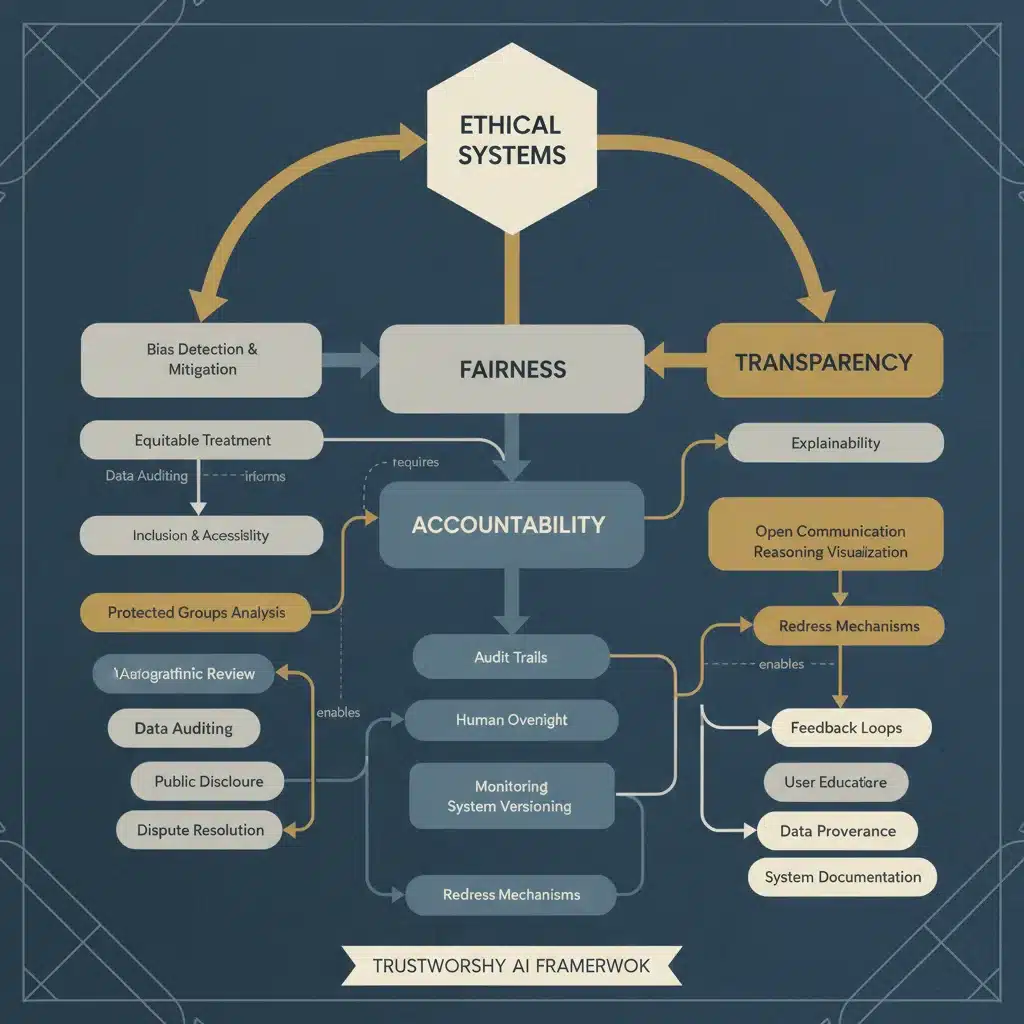
The OECD AI Principles are built upon five value-based principles for responsible AI and five recommendations for national policy and international cooperation. The five value-based principles are particularly relevant for tech companies:
- Inclusive Growth, Sustainable Development and Well-being: AI should be designed to benefit people and the planet, fostering inclusive growth, sustainable development, and individual well-being. This pushes companies to consider the broader societal impact of their AI solutions.
- Human-centred Values and Fairness: AI systems should respect the rule of law, human rights, and democratic values. They should be designed to be fair and unbiased, ensuring equitable outcomes and avoiding discrimination. This principle is central to addressing algorithmic bias, a key concern in AI Ethics Frameworks.
- Transparency and Explainability: AI systems should be transparent and explainable. This means that people should be able to understand how AI decisions are made, the data used, and the logic behind outputs. The degree of explainability may vary depending on the context and risk, but the underlying principle remains.
- Robustness, Security and Safety: AI systems should be robust, secure, and safe throughout their lifecycle. They should be reliable, resilient to attacks, and operate as intended, with clear mechanisms for addressing failures or unintended consequences.
- Accountability: Organizations and individuals deploying AI systems should be accountable for their proper functioning and for respecting the aforementioned principles. This implies clear mechanisms for oversight, redress, and responsibility for AI-driven outcomes.
Integrating OECD Principles into Tech Company Practices
Adopting the OECD AI Principles requires more than just acknowledging them; it demands a fundamental shift in how AI is conceived, developed, and deployed:
- Ethical by Design: Embed these principles from the very initial stages of AI product design. This means conducting ethical impact assessments alongside technical feasibility studies.
- Fairness Audits: Implement regular fairness audits for AI models, especially those impacting critical areas like employment, credit, or healthcare. This includes testing for disparate impact and treatment across different demographic groups. This is a vital component of robust AI Ethics Frameworks.
- Explainable AI (XAI) Initiatives: Invest in research and development of XAI techniques to make AI decisions more understandable to both developers and end-users. Provide clear documentation and user interfaces that explain AI behavior.
- Robustness Testing and Security: Prioritize rigorous testing for adversarial attacks, data poisoning, and system vulnerabilities. Implement strong cybersecurity measures to protect AI models and data.
- Clear Accountability Structures: Define clear lines of responsibility for AI system performance and ethical adherence. Establish processes for external review and mechanisms for users to seek redress if harmed by an AI system.
- Employee Training and Awareness: Educate all employees involved in AI development and deployment about the OECD principles and their practical implications.
By aligning their internal AI Ethics Frameworks with the OECD AI Principles, US tech companies can demonstrate their commitment to global best practices, enhance their credibility, and prepare for a future where international AI governance plays an increasingly significant role.
Framework 3: The IEEE Global Initiative on Ethics of Autonomous and Intelligent Systems
The Institute of Electrical and Electronics Engineers (IEEE) is a global leader in setting technical standards. Its Global Initiative on Ethics of Autonomous and Intelligent Systems has produced a foundational document, ‘Ethically Aligned Design: A Vision for Prioritizing Human Well-being with Autonomous and Intelligent Systems’ (EAD), which offers a practical, engineering-focused approach to ethical AI. For US tech companies, particularly those involved in the core technical development of AI, the IEEE’s guidelines provide indispensable detail for their AI Ethics Frameworks.
Key Principles and Recommendations of IEEE EAD
EAD is built around eight core principles, often referred to as ‘General Principles for the Ethical Design of Autonomous and Intelligent Systems.’ These principles delve deeper into the practical aspects of ethical AI development:
- Human Rights: AI systems should be designed to respect and promote internationally recognized human rights.
- Well-being: AI should be designed to enhance human well-being, considering physical, mental, and social aspects.
- Accountability: Clear mechanisms for accountability must be established, encompassing both technical and organizational aspects.
- Transparency: AI systems should provide a degree of transparency that allows for understanding of their decision-making processes.
- Algorithmic Bias: Developers must actively work to identify, mitigate, and prevent algorithmic bias in AI systems.
- Privacy: AI systems should protect user privacy, adhering to data protection laws and best practices.
- Technical Robustness and Safety: AI systems must be technically robust, reliable, and safe in their operation.
- Environmental Sustainability: The design and deployment of AI systems should consider their environmental impact.
Beyond these principles, EAD provides specific recommendations across various domains, including methodologies for ethical AI, data privacy, autonomous systems, and emotional AI. This level of detail makes it a highly actionable framework for engineers and developers.
Embedding IEEE Guidelines in Technical Development
Integrating the IEEE EAD into a company’s AI Ethics Frameworks requires a proactive engagement from the engineering and technical teams:
- Mandatory Ethical Design Reviews: Incorporate ethical design reviews at every stage of the AI development pipeline, similar to security or performance reviews.
- Bias Detection and Mitigation Tools: Equip data scientists and machine learning engineers with state-of-the-art tools and methodologies for detecting and mitigating bias in datasets and models. This includes techniques like re-sampling, re-weighting, and adversarial debiasing.
- Explainability Requirements: For critical AI applications, mandate the use of Explainable AI (XAI) techniques (e.g., LIME, SHAP) to provide insights into model predictions. This is crucial for accountability and trust.
- Robustness and Adversarial Testing: Implement rigorous testing protocols to ensure AI models are robust against adversarial attacks, data corruption, and unexpected inputs. This is vital for safety and reliability.
- Privacy-Preserving AI: Integrate privacy-enhancing technologies (PETs) such as differential privacy, federated learning, and homomorphic encryption where appropriate, to protect sensitive data used by AI.
- Documentation and Traceability: Maintain comprehensive documentation of AI model development, including data sources, training methodologies, ethical considerations, and testing results. This ensures traceability and accountability.
- Continuous Learning and Updates: Given the dynamic nature of AI, ensure that ethical guidelines and technical implementations are reviewed and updated regularly to address new challenges and best practices.
The IEEE EAD offers a granular, technical roadmap for building ethical AI systems from the ground up. By adopting these guidelines, US tech companies can ensure that their AI products are not only innovative but also inherently responsible and aligned with human values, thus fortifying their AI Ethics Frameworks.
Challenges and Strategies for Adopting AI Ethics Frameworks
Adopting comprehensive AI Ethics Frameworks by Q2 2026 is not without its challenges. Tech companies often grapple with technical complexities, organizational inertia, and the rapid pace of AI innovation. However, with strategic planning and a proactive approach, these challenges can be overcome.
Common Challenges
- Lack of Clear & Unified Regulation: The fragmented regulatory landscape in the US can make it difficult for companies to know exactly which standards to prioritize.
- Technical Complexity: Implementing ethical principles like explainability or bias mitigation can be technically challenging, requiring specialized expertise and tools.
- Organizational Silos: Ethical considerations often require collaboration between legal, technical, product, and business teams, which can be difficult in large organizations.
- Cost and Resources: Investing in ethical AI development, auditing, and training can be perceived as an additional cost rather than an integral part of product development.
- Measuring Ethical Impact: Quantifying and measuring the ethical impact of AI systems can be subjective and difficult.
- Fast-Paced Innovation: The speed at which AI technologies evolve often outpaces the development of ethical guidelines and regulatory frameworks.
Strategies for Successful Adoption
To successfully integrate these AI Ethics Frameworks, US tech companies should consider the following strategies:
- Leadership Buy-in and Culture Change: Ethical AI must be a top-down priority. Leadership needs to champion the cause, allocate resources, and foster a culture where ethical considerations are as important as technical performance and market fit.
- Interdisciplinary AI Ethics Teams: Establish dedicated teams comprising ethicists, lawyers, engineers, social scientists, and product managers. These teams can bridge knowledge gaps and ensure a holistic approach to ethical AI.
- Phased Implementation: Instead of attempting a complete overhaul, adopt a phased approach. Start with high-risk AI systems or new product developments, gradually expanding the scope of ethical review and implementation across the organization.
- Leverage Existing Tools and Standards: While AI ethics is evolving, many existing tools for data governance, privacy, and security can be adapted. Companies should also actively participate in industry forums and working groups to stay abreast of emerging best practices and contribute to the development of new standards for AI Ethics Frameworks.
- Continuous Education and Training: Provide ongoing training for all employees involved in AI development and deployment. This includes not only technical training on bias detection and explainability tools but also ethical reasoning and awareness of societal impacts.
- Transparency and Stakeholder Engagement: Be transparent about the company’s approach to AI ethics. Engage with external stakeholders, including civil society organizations, academics, and the public, to gather feedback and build trust.
- External Audits and Certifications: Consider engaging third-party auditors to assess the ethical robustness of AI systems. As AI ethics certifications emerge, pursuing them can demonstrate a commitment to best practices and enhance credibility.
- Develop Internal Ethical Guidelines: While adopting external frameworks, tailor them to the specific context of the company’s products and services. Develop internal ethical guidelines that are clear, actionable, and integrated into the daily workflow of AI teams.
By proactively addressing these challenges with robust strategies, US tech companies can transform the adoption of AI Ethics Frameworks from a compliance burden into a strategic advantage, ensuring their long-term success and positive societal impact.
The Future of AI Ethics in the US Beyond Q2 2026
The Q2 2026 deadline for adopting critical AI Ethics Frameworks is not an endpoint but a significant milestone in an ongoing journey. The landscape of AI ethics and regulation is dynamic, constantly evolving with technological advancements and societal expectations. US tech companies must view their current efforts as foundational, preparing them for a future that will likely involve even more stringent and harmonized regulations.
Anticipated Regulatory Developments
It is highly probable that the US will move towards more comprehensive federal AI legislation. Inspired by the EU’s AI Act, future regulations might introduce:
- Categorization of AI Risks: A tiered approach to regulation, where AI systems are classified based on their risk level (e.g., unacceptable, high-risk, limited-risk, minimal-risk), with corresponding obligations.
- Mandatory Conformity Assessments: For high-risk AI systems, companies may be required to undergo third-party conformity assessments before market entry.
- Human Oversight Requirements: Specific mandates for meaningful human oversight in AI-driven decision-making processes.
- Data Governance and Quality Standards: Stricter rules regarding the quality, representativeness, and ethical sourcing of data used to train AI models.
- Rights for Individuals: Enhanced rights for individuals to understand and challenge AI-driven decisions that affect them.
- AI Governance Bodies: The establishment of national or regional AI regulatory bodies with enforcement powers.
Companies that have already adopted robust AI Ethics Frameworks based on NIST, OECD, and IEEE principles will be far better positioned to adapt to these future requirements. Their existing infrastructure for risk management, transparency, and accountability will serve as a strong foundation.
The Role of International Harmonization
AI is a global phenomenon, and ethical guidelines are increasingly being harmonized across borders. The OECD AI Principles are a prime example of this. US tech companies operating internationally will benefit immensely from aligning their AI Ethics Frameworks with globally recognized standards. This will reduce compliance burdens across different jurisdictions and facilitate international collaboration and market access.
Continuous Evolution of Ethical AI Practices
The field of AI ethics itself is continuously evolving. New ethical challenges emerge with advanced AI capabilities, such as generative AI, synthetic media, and autonomous decision-making in complex environments. Companies must foster a culture of continuous learning and adaptation, regularly reviewing and updating their AI Ethics Frameworks to address these new frontiers. This includes:
- Investing in AI Ethics Research: Supporting internal or external research into emerging ethical dilemmas and solutions.
- Participating in Policy Dialogue: Engaging with policymakers, academics, and civil society to shape the future of AI governance.
- Developing Metrics for Societal Impact: Moving beyond technical metrics to develop robust ways of measuring the positive and negative societal impacts of AI.
The journey towards ethical AI is ongoing. By embracing the Q2 2026 deadline as a catalyst for fundamental change, US tech companies can not only ensure compliance but also cement their role as responsible innovators, building a future where AI truly serves humanity’s best interests.
Conclusion: A Strategic Imperative for Responsible AI
The Q2 2026 deadline for US tech companies to adopt critical AI Ethics Frameworks represents a defining moment for the industry. It underscores the growing recognition that the immense power of AI must be tempered with equally robust ethical considerations and accountability mechanisms. The frameworks provided by NIST, the OECD, and IEEE offer comprehensive, actionable roadmaps for navigating this complex terrain.
The NIST AI RMF provides a structured approach to identifying, measuring, and managing AI risks, embedding ethical considerations throughout the AI lifecycle. The OECD AI Principles offer a value-based foundation, emphasizing human-centered design, fairness, transparency, and accountability. Finally, the IEEE Global Initiative, with its ‘Ethically Aligned Design,’ provides detailed, engineering-focused guidance for building ethical AI systems from the ground up.
Adopting these AI Ethics Frameworks is no longer a matter of corporate social responsibility alone; it is a strategic imperative. Companies that proactively integrate these principles will not only mitigate significant legal, financial, and reputational risks but will also gain a competitive advantage built on trust, innovation, and long-term sustainability. They will be better positioned to attract top talent, secure investment, and build AI solutions that genuinely contribute to societal well-being.
The path to responsible AI requires commitment, investment, and a willingness to adapt. By embracing these critical AI Ethics Frameworks now, US tech companies can ensure they are not just complying with future regulations, but actively shaping a future where AI serves as a force for good, responsibly and ethically. The time for action is now, to build a trustworthy and beneficial AI ecosystem for all.